
Chicken Road casino game in the UK: what to know
 Available in GB
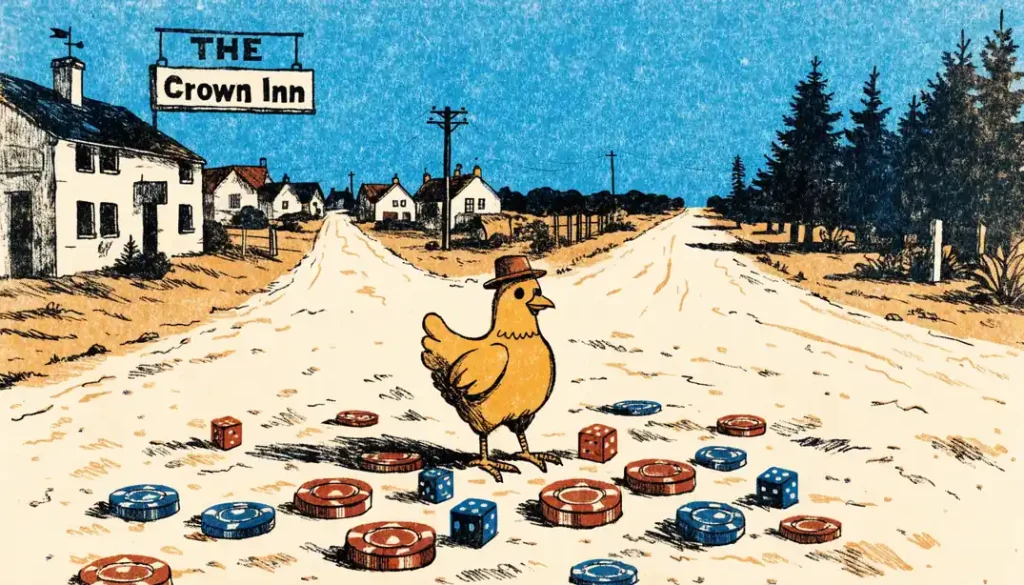
A practical guide to casino access, crash-game claims, demos, offers, payments and account controls.
What “slot” tells you—and what it does not
The word “slot” identifies a type of casino language, but it does not by itself describe how a particular title works. When you see a phrase such as “Chicken Road casino slot”, the safest interpretation is that the game is being associated with a casino machine or slot-style product. That association is not evidence of its rules, visual design, payout structure, or technical classification.
A casino game is an arrangement in which you stake cash or chips on an outcome, or on a combination of outcomes. The result may be favourable or unfavourable to you. A winning result can produce a short-term gain, while a losing result reduces the amount available for later play. The central point is that the stake is exposed to uncertainty: you do not control the result simply by choosing when to place it.
What a slot machine normally means
In ordinary casino terminology, a slot machine is a gambling machine generally used by one player at a time. It does not normally require a dealer or croupier to decide the result. You select a stake or other available options, start a game cycle, and receive an outcome generated by the machine’s game system.
Modern digital machines use random-number technology. A computer or other gaming equipment generates selected random numbers, and the game translates the relevant result into the symbols, values, positions, or other display shown to you. The visible animation is therefore not the same thing as the process that determines the result. A spinning reel or moving character may make the outcome easy to watch, but the presentation alone does not explain the underlying rules.
This is why the phrase “Chicken Road slot game” should not be treated as a technical description. It may reflect the way a casino product is labelled, the way a publisher groups its titles, or simply the way people describe a game with a slot-like interface. Without confirmed information about the title, the word “slot” cannot establish whether it uses reels, lanes, rounds, multipliers, fixed symbols, or another format.
Casino Games: Slots, Live Tables and Game Types
Random does not mean uncontrolled
Random-number games are not normally intended to produce a pattern that you can learn and exploit from recent results. Each game cycle is processed by the relevant random-number system. Previous outcomes do not become instructions for the next one merely because a sequence appears unusual.
That does not mean every casino game is identical. A title may have its own rules for qualifying outcomes, stake options, prizes, or combinations. Those details determine how the game presents risk and reward. The general random-number principle only explains how selected outcomes can be generated; it does not supply the missing rules for a particular Chicken Road title.
The display can also affect how you interpret the game. A machine-like interface may show animated objects rather than traditional fruit symbols. It may use a road, a character, a card, or another theme. Those graphics describe the presentation, not necessarily the mathematical structure. Calling something a “slot machine game” because it has a start button and an animated result can therefore be too broad to establish what happens during play.
Keno Casinos in the UK: Draws, Payouts and Checks
The casino’s mathematical advantage
Casino games are generally designed with a predictable long-term advantage for the casino. This does not mean the casino wins every individual game cycle. You may receive a winning outcome and make a short-term gain. It means that, across the game’s intended operation, the relationship between stakes and possible returns is structured so that the casino expects to retain an advantage.
That distinction matters when assessing any title described as a slot or casino game. A single successful round does not demonstrate that the game is profitable for players overall. Conversely, a losing round does not prove that the next round must win. Short-term results can vary, while the long-term mathematical design remains unchanged.
The advantage is not visible merely from a game’s name. “Chicken Road slot”, “slot chicken road”, and similar wording says little about the probability of outcomes or the value of prizes. To understand those elements, you would need the actual rules and the relevant game information supplied for that title. A familiar category label cannot replace those details.
Market
United Kingdom
Language
English
Game Context
Casino product
Do not infer mechanics from the title
A name can suggest a theme without telling you how a game operates. “Chicken Road” might evoke movement across a road, but that image does not confirm that the player controls movement, selects a route, avoids hazards, or advances through stages. It also does not confirm that the game is a conventional slot, a different random-number game, or a product that combines several features.
The same caution applies to the plural wording “Chicken Road slots”. It may refer to one title described in different ways, several products with related names, or informal grouping by users or operators. The wording alone does not establish that multiple slot machines exist.
Before treating the title as a specific type of casino game, separate three questions:
- What is being staked? This identifies the financial exposure during a game cycle.
- How is the outcome generated? A random-number system may determine selected results, but the particular rules still matter.
- What determines a win or loss? The title’s rules must explain which outcomes qualify and what they return.
The term “slot” can help place a product in a broad casino context. It cannot, on its own, verify Chicken Road’s mechanics, category, or payout behaviour. That boundary keeps the description accurate: the game may be presented as a slot, but its operation must be established from its own documented rules rather than inferred from the name.
How online access depends on the casino’s market
An online casino game is not available simply because a website displays its name. Availability depends first on whether online casino gambling is permitted in the relevant market and, second, on the type of operator offering access. The same game title may therefore appear in different commercial environments, with different regulatory arrangements behind the website.
For a player in the United Kingdom, this distinction matters when looking for an online version of Chicken Road. A page describing a Chicken Road casino game online does not by itself establish that the operator may legally serve British customers, that the game is currently offered, or that an account can be opened from the UK. The operator’s market is a separate question from the title shown on its games page.
Hi-Lo Casino UK: Understanding Live Search Results
Two operator markets in the UK
A specialist review describes the UK online casino market in 2026 as having two parallel parts. One is the UK Gambling Commission, or UKGC, space. The other consists of offshore platforms that operate outside the UKGC system. This is a description of market structure, not proof that any particular Chicken Road online casino is present in either part.
UKGC-licensed operators are subject to the British licensing framework when they offer remote gambling to customers in Great Britain. Online gambling is legal in the UK only through licensed and regulated sites. Consequently, a UKGC operator’s website is part of a locally regulated market, with the obligations that accompany that status.
Offshore casinos accepting UK players operate outside the UKGC space. Their accessibility to a UK resident does not turn them into UKGC-licensed operators. The terms “non GamStop sites” and offshore casinos are often used when discussing this separate market, but neither expression means that a platform holds a UKGC licence.
UKGC-licensed
Subject to the British licensing framework and regulated for remote gambling in Great Britain.
Offshore
Operate outside the UKGC system and are not locally regulated.
This distinction should remain clear when you assess a page presenting an online casino Chicken Road game. A website can be reachable from the UK while belonging to an offshore market. Reachability and UKGC licensing describe different properties: the first concerns whether the site can be accessed, while the second concerns the regulatory system under which the operator works.
What a title on a website proves
A game title can be used in a casino lobby, a promotional page, or an account area. Those locations do not all provide the same information. A lobby may show a title without proving that it is available to every customer. A promotional page may refer to a product without establishing that the page is directed at UK residents. A login page only indicates that the operator has an account-entry function; it does not prove that a specific game is available after signing in.
That is why searches for a Chicken Road casino login or a Chicken Road game casino login should not be treated as evidence of a dedicated account system for that game. Casino accounts are normally created with the operator, not with an individual title. Whether the game can be opened after login depends on the operator’s catalogue and the market in which the account is being used.
The same caution applies to wording that calls the title a slot, a crash game, or an online casino game. Those labels may reflect how a page is categorised or described, but they do not establish which operators offer it to UK customers. The access question must be settled independently from the label.
Casino Dice Games in the UK: Rules and Formats
Why the market distinction changes the answer
When you encounter a page for a Chicken Road online casino game, identify the operator’s market before treating the page as a route to play. A UKGC site belongs to the regulated British framework. An offshore site may accept UK players while remaining outside that framework. These are not interchangeable routes, even if both display similar casino terminology or allow a visitor to reach a registration or login screen.
The distinction also prevents a common error with searches for Chicken Road 2 online casino or Chicken Road 2 casino online. A result that mentions a possible sequel does not show that the title exists in a UKGC casino catalogue. It may instead be an offshore listing, an informational page, or a reference whose availability is limited to another market. The operator’s status and the game’s actual listing must be considered separately.
Online casino access is therefore conditional rather than universal. Casino games may be offered online where the law permits them, but a title’s presence on a website does not override the rules applying to that operator. For a UK player, the meaningful division is between the UKGC market and offshore platforms outside it. That division tells you what kind of market you are viewing; it does not, by itself, confirm that Chicken Road is offered by a particular casino.
Crash-game searches and the limits of bonus claims
A crash-style description tells you what people may be looking for, not what a particular Chicken Road title actually does. The name may be associated with a road-crossing theme, a rising-risk format, or another casino presentation, but the label alone does not establish the rules, outcome system, provider, or reward structure. Treat the game description and the promotion attached to it as separate questions.
A crash-style description or a reward banner does not confirm the specific rules, provider, or mechanics of the Chicken Road title.
The same separation matters when a casino advertises “rewards”. A reward is not automatically cash that can be withdrawn immediately. It may be bonus funds, free spins, or another incentive governed by conditions. Those conditions determine which games qualify, how much wagering is required, when the offer expires, and whether winnings from a bonus remain subject to a cap. The title Chicken Road does not, by itself, prove that any such promotion exists or that a named casino offers it.
What wagering requirements change
A wagering requirement links a bonus to a required amount of play before withdrawal is allowed. The calculation is based on the bonus amount and the stated multiplier. For instance, a £100 bonus carrying a 35x wagering requirement creates £3,500 in required bets before the bonus balance can be cashed out. That is the total value of stakes, not a promise that you will lose or win that amount. Each bet changes the balance according to its result, while the requirement continues to measure the qualifying turnover.
This distinction is easy to miss in a crash-game promotion. A player might see a reward described beside a game and assume that every stake in that game contributes equally. The terms may instead define eligible products, exclude certain games, or apply different contribution rules. You need the written conditions to determine whether play on the advertised title counts and which balance is subject to wagering.
Mines Casino Game UK: Randomness and Free Play
Since 19 January 2026, gambling incentives cannot impose wagering of more than 10x the bonus funds. A specialist review reported this change, but the practical detail still belongs in the individual offer’s terms: the requirement may be lower, and other conditions can affect withdrawal. The cap is not evidence that a Chicken Road promotion exists, nor does it turn an unverified crash-game claim into a confirmed product feature.
Keep casino and betting rewards separate
An incentive cannot combine different gambling product types, such as casino play and betting, as a single route to unlock the reward. This matters when promotional wording places casino games, sports betting, and other products on the same page. A reward presented near a Chicken Road title should identify the relevant casino activity rather than requiring you to move between unrelated gambling products.
The restriction also gives you a practical way to read an offer. Check what product the incentive covers, what stakes qualify, and whether the terms describe one balance or separate balances. A headline can mention several forms of entertainment without proving that they share eligibility. The qualifying activity must be clear in the conditions.
Caps can limit promotional winnings
Free spins have their own common limitation: many casino offers cap the winnings that can be retained from those spins. If the spins produce more than the permitted amount, the terms may allow you to keep only the stated maximum. The existence of a cap does not depend on whether the underlying game has a chicken theme or a crash-style presentation; it is a condition of the promotion.
Attention
Free spin winnings may be subject to a cap, meaning you may only be permitted to keep a stated maximum amount.
Do not confuse a capped free-spin reward with a cap on ordinary cash play. They are different balances and different terms. A promotion may also specify which games receive the spins, when they must be used, and how resulting winnings are treated. Read those clauses before treating a displayed reward as part of the game itself.
For Chicken Road searches, the reliable boundary is therefore narrow. A crash label does not confirm the game’s mechanics, and a reward banner does not confirm a game-specific bonus. What can be assessed is the incentive’s written structure: its wagering requirement, eligible gambling product, and any limit on winnings. The title becomes relevant only if the operator’s terms explicitly include it.
What the UK rules mean for casino play in 2026
For a real-money casino game to be offered legally to customers in Great Britain, the operator must hold the appropriate licence from the UK Gambling Commission (UKGC). This requirement applies whether the operator is based in Britain or elsewhere. The relevant legal framework includes the Gambling (Licensing and Advertising) Act 2014, which requires an operator taking bets from British residents to be licensed.
French Roulette Online Casinos in the UK: Rules
That requirement concerns the operator, not the name used for a game. A title containing words such as “casino”, “road”, or “game” does not establish that it is legal to play for money, nor does it show which gambling category the title belongs to. The practical test is whether the operator offering the real-money activity is licensed for the British market.
This distinction matters when assessing a Chicken Road casino game in 2026. The title may be presented in different ways by different websites, but the wording alone cannot replace an operator’s regulatory status. If a site offers real-money play to customers in England, Scotland or Wales, it must have a UKGC licence. A website operating without that licence is not brought inside the British regulatory system merely by accepting UK customers or displaying prices in pounds.
Stake limits for online gambling machines
Separate rules apply where the activity is an online slot or another gambling machine subject to the relevant stake controls. The maximum stake for a single game cycle is £5 for players aged 25 and over. Players aged 18 to 24 are subject to a £2 maximum per game cycle. The £5 limit for all adults came into effect on 9 April 2025.
UK Stake Limits
For players in the UK, the maximum stake for a single game cycle is £5 for those aged 25 and over, and £2 for players aged 18 to 24.
A specialist review reports these age-based limits as applying to spins. In practical terms, the permitted stake depends on the player’s age and on whether the game is treated as an online slot within the regulated gambling system. You should therefore avoid inferring the limit from the title alone. “Chicken Road” does not, by itself, prove that the game is a slot, a gambling machine, or another type of casino product.
The age distinction also does not remove the general age requirement for gambling. Online gambling in the UK is legal for players aged 18 and over when the operator holds a UKGC licence. Operators must verify a customer’s age before allowing deposits into a gambling account, so access to a game cannot lawfully be based only on a declaration made during registration.
Applying the rule to a casino listing
When you encounter a listing for a Chicken Road casino, separate three questions:
- Is the operator offering real-money gambling to British customers?
- If so, does it hold the required UKGC licence?
- Is the game actually an online slot or gambling machine to which the stated stake limits apply?
The first two questions concern the operator and its licence. The third concerns the game’s regulatory classification. They are related, but they are not interchangeable. A licensed casino can offer different categories of games, and a game’s branding cannot determine its category.
For a UK player, the licence is therefore the starting point for lawful real-money access. The stake rules become relevant only after the activity and its classification are established. That approach avoids treating a product label as evidence of either regulatory approval or game mechanics.
Recommended online casinos
- EvoSpinBonus: 125% up to €2500 + 125 Free Spins · Payout speed: 1-3 business days
- x3betBonus: Welcome Pack 100% Up to £1.000 + 200 Free Spins · Payout speed: 1-3 business days
- BeOnBetBonus: 100% up to €500 + 100 FS · Payout speed: 1-3 business days
- Revery PlayBonus: 100% up to€1,000+ 100 FS · Payout speed: 1-3 business days
- SpinFormulaBonus: 550% Up To £15,000 + 550 FS · Payout speed: 1-3 business days
- NightWinBonus: £900 + 400 free spins · Payout speed: 1-3 business days
- DieselwinBonus: Welcome Pack 250% up to £4000 + 200 FS · Payout speed: 1-3 business days
What a demo search can—and cannot—confirm
A page that mentions a Chicken Road casino demo does not, by itself, establish that a playable demo exists. The word “demo” may appear in a title, description, comparison, or promotional text without linking to an actual game mode. You need to distinguish a description of a supposed feature from access to that feature.
A usable demonstration mode would need to be identifiable within a specific game interface or casino account. The page should make clear which game is being offered, whether the mode is separate from real-money play, and what actions are available to you. A general statement that a casino has free games does not prove that Chicken Road is among them.
The same applies when the game is described as a casino game. That label does not confirm its format, provider, rules, random-number system, or availability at a particular operator. A road-crossing theme is not enough to determine how the game functions. The title alone cannot show whether a demonstration mode uses virtual credits, reproduces the real-money interface, or has different settings.
You should also separate three different claims:
- a casino website contains information about Chicken Road;
- the website provides a playable non-real-money mode;
- the website accepts real-money play for that specific game.
Each claim requires its own evidence. A page may support one without supporting the others. For instance, an operator could discuss a game without offering it, or provide a free-play page without making the game available for stakes. A reference to real-money casino play is therefore not proof that a demo is available, and a demo reference is not proof that real-money play can be opened.
Search results mentioning Chicken Road 2 require the same separation. The appearance of “demo” beside that name does not verify a playable version, a relationship with the original title, or an offer from a particular casino. Treat the wording as an indication of what the page discusses, not as confirmation of what you can launch.
Before relying on a demo claim, look for a direct game screen, an unambiguous play control, and terms explaining whether money is involved. The operator offering the mode should also be identifiable. If the page supplies only a title, an image, or a short promotional sentence, it confirms only that the page uses those words. It does not establish that Chicken Road has a demo, how such a mode would operate, or where you can play it.
Verification Checklist
- A demo reference is not proof of a playable non-real-money mode.
- A casino listing does not guarantee the game is available to all users.
- An operator’s mention of a game does not confirm its regulatory category.
Free play, reviews and the terms behind offers
“Free” can describe several different arrangements, and they do not carry the same meaning. A game being playable without a cash stake might refer to a practice mode, a promotional balance, or a no-deposit bonus. These are separate concepts. The existence of one does not prove the existence of the others, and the word “free” does not establish that Chicken Road can be played without registration, payment or wagering conditions.
A no-deposit bonus has a specific meaning: it is casino bonus money granted without requiring you to spend your own money first. That does not necessarily make every resulting win immediately withdrawable. The bonus may be subject to eligibility rules, a time limit, game restrictions, identity checks or wagering requirements. You need to read the offer terms rather than treat “no deposit” as equivalent to unrestricted free play.
Deposit-based welcome packages work differently. They may divide the reward into stages, with a minimum deposit applying to each stage. A specialist review reports thresholds commonly set at around £10 to £20, but that is an observation about the offers it examined, not a universal condition for every casino or every game. The exact threshold belongs to the individual promotion. If you deposit less than the required amount, the relevant stage may not activate even if the account otherwise qualifies.
The arithmetic of a wagering requirement is also important. If bonus funds carry a 35x requirement, receiving £100 in bonus funds would mean placing £3,500 in qualifying stakes before withdrawal becomes available under that condition. The amount wagered is not the same as the amount lost: each bet counts according to the promotion’s rules, while the balance can rise or fall during play. A requirement therefore creates exposure to further gambling rather than guaranteeing a route to cashing out.
Aviator Casino Game in the UK: How It Works
Reviews need the same separation between description and proof. A review may discuss an offer, a casino’s interface or a claimed game title, but it cannot by itself establish that Chicken Road has a free-play mode, that a particular operator offers it, or that Chicken Road 2 is available. Treat statements about “free spins”, “free casino play” and no-deposit access as claims about a specific promotion until its current terms identify the game, eligibility conditions and withdrawal rules.
Playing on a site: payments and account controls
When you open an online casino account, access to a game is only one part of the process. The account also controls how you fund play, request a withdrawal and set limits. That distinction matters when you are looking for a way to play Chicken Road at a casino: payment methods and account tools belong to the operator, not automatically to the game.
Open Banking and Faster Payments have made transfers to and from online casinos less cumbersome. A payment can move through the banking system without requiring the game itself to provide a separate banking function. The available method, however, depends on the platform and the account conditions attached to it. A search for a Chicken Road casino with PayPal should therefore not be treated as evidence that PayPal is supported, and the same applies to any other named payment service.
Do
- Set account limits before funding.
- Check individual promotion terms and conditions.
- Verify the operator’s UKGC licence status.
Don’t
- Assume a game title defines its mechanics.
- Treat “free” as meaning no wagering requirements.
- Infer a sequel exists just from a name.
Speed also has two separate parts. A deposit may be credited quickly, while a withdrawal can involve account checks before money is released. A specialist review has reported that some platforms credit deposits immediately and complete withdrawals within hours instead of days. That is a statement about the platforms covered by that review, not a universal property of every casino or of Chicken Road. You need to read the payment page and withdrawal conditions for the particular account.
The same separation applies to mobile access. A casino website may adapt to a phone screen, while an operator may also provide a separate application. Nothing about the phrase “Chicken Road casino app” establishes that the game has its own app, that a casino has produced one, or that a mobile version is available. The relevant question is whether the chosen operator lets you access its casino account through your device.
Account controls are more important than an app label. Platforms in this part of the market generally provide tools such as:
- deposit limits, which restrict how much you can add;
- session timers, which show or constrain time spent in the account;
- self-exclusion, which blocks access for a chosen period under the platform’s procedure.
These controls operate at account level. They do not change the outcome of an individual game round, but they can limit when you can deposit or continue playing. Set the available limits before funding the account, and check how a withdrawal request, identity review or self-exclusion action affects access. A payment button, mobile interface or game title should never be mistaken for a guarantee about any of those account functions.
Chicken Road 2: what is not verified
The name “Chicken Road 2” suggests a sequel, but a title alone does not establish that a second game exists. It may refer to a genuine follow-up, an informal label used by players, a page title created by an operator, or a mistaken description of another casino product. These possibilities have different implications, so they should not be treated as interchangeable.
A page using the sequel name does not, by itself, confirm a game’s developer, release status, rules, payout structure or gambling category. It also does not prove that the product is available in the UK, appears at a particular casino, or can be played for real money. Availability depends on the operator and the market in which that operator offers games; the wording of a page cannot replace those checks.
The same caution applies to claims that the second version is newer, faster, more rewarding or mechanically different. No such comparison follows from the number in the title. You would need an identifiable game description and consistent information about its operation before comparing it with anything called Chicken Road. Without that, statements about improved features or changed gameplay are speculation.
A casino listing can also create confusion between a game name and a search label. Some pages group products by theme, while others use broad wording to attract visitors looking for a particular title. The presence of “2” in a heading therefore does not demonstrate that the page represents a separate release. Read the actual game information, including the provider identification and the rules shown in the interface, where those details are supplied.
Does a sequel necessarily exist?
A name like “Chicken Road 2” might be an informal label, an operator’s page title, or a mistake, rather than a confirmed follow-up.
Can I assume the game is a slot?
No, the title alone cannot establish if it uses reels, lanes, or other formats; you must check the documented rules.
Is every offshore site illegal?
Offshore sites operate outside the UKGC space; while they may be reachable from the UK, they are not part of the regulated British market.
For a UK player, the practical question is narrower: does a particular licensed operator clearly identify Chicken Road 2 as an available game under its current offering? If the title appears only in promotional text or an unexplained page heading, treat the claim as unconfirmed. Do not infer a sequel from a name alone, and do not assume that information attributed to one product applies to another.
How casino game categories differ
A chicken-crossing theme does not, by itself, identify the type of casino game involved. The same visual idea could be attached to different systems, and the wording used to describe it does not explain what happens when you place a stake. To classify a Chicken Road casino game, you would need to know how outcomes are produced, who operates the game, and whether a dealer is involved.
Gambling machines
A gambling machine is generally designed for one player at a time. You interact with the game through the machine or its digital equivalent, while the outcome is handled by the equipment rather than by a casino employee. A road-crossing design could therefore appear in this category, but the theme alone cannot establish that it does.
The important feature is the operating arrangement: you make the selection or stake, the equipment determines the result, and no croupier needs to conduct each round. Labels such as “casino game” or “crossing game” do not provide that technical information.
Table games
Table games work differently. They are played against the casino, not as a contest between individual players, and they are generally run by croupiers or dealers. The dealer may manage the round, present cards or other equipment, and apply the rules that determine how the result is settled.
Crazy Time Live Casino Game Show in the UK
If a chicken road concept were presented with a live or automated dealer structure, that could point towards a table-game format. However, a road-crossing image is not evidence that such a format exists. It describes a subject or presentation, not the underlying category.
Random-number games
Random-number games use selected numbers generated by a computer or other gaming equipment. Here, the central question is how the result is generated, rather than whether the screen shows a chicken, a road, cards or another theme.
This distinction matters when assessing a phrase such as “chicken road game casino”. It may identify the intended subject, but it does not reveal whether the game is a gambling machine, a table game or a random-number game. A promotional reference, including a request for a Chicken Road casino promo code, adds information about an offer rather than the game’s category. The rules and interface must be examined separately before you assign it to one of these groups.
Finding a casino that offers Chicken Road
A casino offering Chicken Road would need to make the game available through its online gambling service. Online casino games can be offered where the law permits them, but availability is determined by the operator’s catalogue and the market it serves. The presence of a casino website, by itself, does not establish that this particular game is included.
JetX Casino Game in the UK: Demos and Risk
For a UK player, the operator’s regulatory position is also part of the distinction. A UKGC-licensed casino operates within the UK regulatory system. An offshore casino may accept customers from the UK while operating outside the UKGC space. These are not equivalent arrangements: an offshore site does not hold a UKGC licence, even when its website is accessible to UK players.
That means a claim that a casino has Chicken Road should be treated as an operator-specific statement. It does not follow from the game’s name, from the general availability of online casinos, or from another site’s catalogue. The relevant question is whether the operator currently lists and supplies the game in the market available to you.
You should therefore separate three points: whether online casino games are legally offered in the relevant market, whether the operator accepts UK players, and whether Chicken Road appears in that operator’s actual games catalogue. Keeping those points separate prevents a general statement about casino access from being mistaken for confirmation that a particular casino offers Chicken Road.