
Keno Casinos in the UK: Draws, Payouts and Checks
 Available in GB
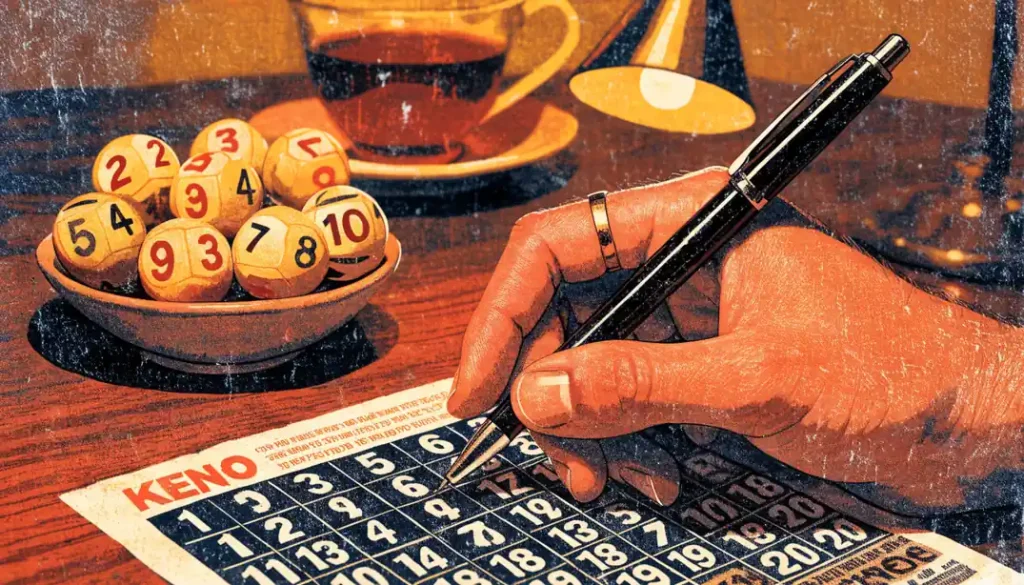
Keno outcomes depend on the overlap between selected numbers and the draw, while stake sets the monetary value of a result.
How Keno Draws and Payouts Work
Keno is a number-draw game in which you select numbers before the draw takes place. The result is determined by two separate parts of the game:
- the stake attached to your entry; and
- how many of your selected numbers also appear in the draw.
Those two factors are linked in the final payout. The draw establishes how many selections you matched, while the stake determines the monetary value assigned to that result.
Your selection and the draw
An entry begins with a group of numbers chosen on the keno ticket or game screen. These are the numbers against which the draw will be compared. The draw then produces its own result. Afterward, the game counts the numbers that appear in both groups.
That count is the number of matches, or hits. It is not the total number of numbers you selected, and it is not the total number produced by the draw. It is only the overlap between the two.
For instance, if your ticket contains selected numbers and the draw contains a different set, the game checks each selection against the result. A number contributes to your match count only when it is present in both places. Numbers that you selected but that do not appear in the draw do not count as hits. Numbers drawn that were not on your ticket do not count either.
This comparison is the basic mechanism behind online keno games. The screen may present the process with animated balls, a grid, a ticket, or a slot-style interface, but the payout calculation still depends on the match count and the stake.
Casino Games: Slots, Live Tables and Game Types
How the stake affects the payout
The stake is the amount attached to the entry. It does not change which of your selected numbers appear in the draw. Instead, it sets the scale of any payout associated with the result.
The game applies its payout table to the number of matches. That table specifies what a particular match result is worth for the chosen entry. The value may be expressed as a return linked to the stake, so changing the stake changes the monetary result while leaving the match count unchanged.
Imagine two entries with the same selections and the same draw result. If one entry carries a smaller stake and the other carries a larger stake, they have the same number of matches. Their cash payouts can nevertheless differ because the stake used in the calculation is different. The draw result has not become more favourable; only the amount attached to it has changed.
This distinction matters when reading a keno casino game interface. A large displayed payout may reflect the stake connected with the entry, the match category, or both. It should not be read as a fixed amount that applies to every ticket.
The payout table is the missing link
A match count by itself does not tell you the cash value. To calculate the result, you need the payout table for that game. It connects each possible number of hits with the return attached to the selected stake.
The payout table connects each possible number of hits with the return attached to the selected stake, serving as a fundamental part of the game mechanics.
The table can show that different match counts have different outcomes. A result with more matches is not simply described by the number of numbers drawn; it is evaluated against the game’s stated payment rules. The table is therefore part of the game mechanics, not optional background information.
When examining online casino keno games, read the table alongside the ticket controls. Check which stake the displayed figures refer to and whether the figures are shown as cash values or as a return associated with the stake. Without that context, a payout figure can be easy to misinterpret.
What happens after the draw
Once the draw finishes, the game identifies the matching numbers, counts them, and checks that count against the payout table. The result is then calculated from the table and the stake attached to the entry.
There are therefore three separate values to keep apart:
- Selected numbers: the numbers placed on your entry.
- Matches: the selected numbers that also occur in the draw.
- Payout: the amount produced when the match result is assessed using the stake and the game’s payout table.
This structure applies whether the presentation resembles a traditional keno ticket, a digital number board, or keno slot games. A demo version may display the same sequence without requiring a monetary stake, while a real-money game attaches the selected stake to the entry. The visual format does not replace the underlying calculation.
To understand how to play a keno casino game, focus first on this chain: select numbers, attach a stake, observe the draw, count the matches, and read the corresponding payout. The draw supplies the result; the stake supplies the monetary scale; the payout table connects the two.
Recommended online casinos
- EvoSpinBonus: 125% up to €2500 + 125 Free Spins · Payout speed: 1-3 business days
- x3betBonus: Welcome Pack 100% Up to £1.000 + 200 Free Spins · Payout speed: 1-3 business days
- BeOnBetBonus: 100% up to €500 + 100 FS · Payout speed: 1-3 business days
- Revery PlayBonus: 100% up to€1,000+ 100 FS · Payout speed: 1-3 business days
- SpinFormulaBonus: 550% Up To £15,000 + 550 FS · Payout speed: 1-3 business days
- NightWinBonus: £900 + 400 free spins · Payout speed: 1-3 business days
- DieselwinBonus: Welcome Pack 250% up to £4000 + 200 FS · Payout speed: 1-3 business days
Choosing Numbers When Each Draw Is Independent
Each keno draw is a separate random event. The numbers that appeared in an earlier draw do not alter the numbers available in the next one, and they do not make any particular number more or less likely to appear. This remains true whether you play at a keno casino online, a UK online keno casino, or another gambling site using the same type of draw.
That principle rules out several common selection theories:
- A number is not “due” because it has been absent from recent draws.
- A number is not safer because it appeared repeatedly before.
- A previous sequence does not create a trend that the next draw must continue or reverse.
- A group of numbers that looks balanced is not more likely to be selected than another group of the same size.
- Reusing a previous selection does not make a future result more or less likely.
The important distinction is between selecting numbers and changing probabilities. You can choose the numbers yourself, use an automatic selection, or select a familiar pattern on the board. Those methods change which outcome would count as a win for your ticket, but they do not change the random draw itself.
Why past results are easy to misread
Suppose a number has not appeared for several draws. It may feel increasingly likely to return, because repeated absence looks unusual. Independence means that the next draw has no memory of that absence. The number has not accumulated an advantage, and the draw does not compensate for earlier results.
The same error works in the opposite direction. A number that appeared recently may seem temporarily favoured, or “hot”. That conclusion also relies on treating unrelated draws as if they were connected. A run of appearances can occur by chance without creating a reason for another appearance or for a sudden disappearance.
Looking at historical results can describe what happened, but it cannot identify a reliable way to control the next result. A chart of past draws is therefore a record, not a forecasting tool.
Live Baccarat Online Casinos in the UK: What to Check
What number-selection choices actually change
Your selection still matters to the structure of your ticket. Choosing more or fewer spots changes the set of combinations that can produce a result, while choosing particular numbers determines which combinations are relevant to you. These are features of the ticket, not methods for influencing the draw.
Personal rules can therefore be useful for organisation, but not for improving the random process. You might avoid repeating selections, use the same numbers for convenience, or let the game choose them automatically. None of these approaches has a built-in advantage merely because it appears systematic. A pattern such as consecutive numbers, a diagonal on the display, or a spread across the board is still just one selection.
The same applies when comparing an online keno casino with a site promoted as a best keno casino UK option, including services that advertise bitcoin payments. The payment method and presentation do not turn an independent draw into a predictable one. For Great Britain, keno offered by a licensed operator falls under UK Gambling Commission regulation, but regulation does not make any number-picking strategy predictive.
Attention A house edge for online keno can range from approximately 5% to 25% depending on the casino and the number of spots selected.
A specialist affiliate review has placed the house edge for online keno in a range from approximately 5% to 25%, with the stated variation linked to the number of spots selected and the casino. That figure concerns the game’s return characteristics, not a way to identify winning numbers. Number selection cannot remove the underlying mathematical disadvantage described by the game’s terms.
How to Assess a Keno Casino in the UK
When you assess a keno casino serving customers in Great Britain, start with its legal operating structure rather than its game selection, design or promotional language. The important question is whether the business providing the gambling service is authorised to offer remote gambling to people in Great Britain.
The UK Gambling Commission regulates commercial gambling in Great Britain, including gambling delivered online. It is the sole regulator for commercial gambling in this part of the UK. Its responsibility applies to the gambling activity offered to the customer, not merely to the place where the operator, software company or technical equipment is located.
That last point matters because an online casino may have a company, server or support operation outside Great Britain. A foreign location does not remove the requirement to comply with the rules applying to remote gambling offered to British consumers. If a site accepts customers in Great Britain and offers keno as a gambling product, its operating arrangement must account for that activity under the British regulatory framework.
Identify the business behind the site
A casino website is a customer-facing brand, but the brand is not necessarily the legal operator. Before treating a site as a lawful option, find out which business actually provides the gambling service. The relevant details may appear in the site’s terms, licence information or company information.
You are looking for a clear connection between:
- the website offering keno;
- the business responsible for the gambling service; and
- the operating authorisation covering remote gambling in Great Britain.
This distinction prevents a common error: assuming that a familiar brand name is itself the licensed entity. A site can present one commercial identity while another company holds the operating licence. The legal assessment therefore concerns the responsible operator and the arrangement under which the site supplies gambling, not just the wording used in its branding.
Understand a remote operating licence
A remote licence is the authorisation relevant to gambling supplied through the internet or another remote channel. A casino operating legally for customers in Great Britain must hold the appropriate remote licence, either directly or through a lawful white-label arrangement with an existing licence holder.
The Gambling Commission issues operating licences to businesses. It also issues personal licences to individuals who perform specified operating roles. These are different forms of authorisation. A personal licence held by an individual does not replace the operating licence required by the business providing the gambling service.
For a keno site, the key issue is therefore the business-level permission to operate remotely. A statement that the company, owner or manager is licensed is not, by itself, enough to establish that the website’s gambling service is covered.
A casino must hold an appropriate remote licence, either directly or through a lawful white-label arrangement, to offer gambling services to customers in Great Britain.
How white-label arrangements work
A white-label arrangement separates the public brand from the company holding the operating licence. The brand may control the customer-facing presentation, while an existing licensed operator supplies the regulated gambling framework behind it.
This structure can be lawful. It does not mean that a brand may operate without oversight or that any licence held somewhere in a corporate group automatically covers every website. The specific relationship between the brand and the licence holder matters.
When a casino uses a white-label model, you should be able to determine which licensed operator is responsible for the gambling service. The site should not leave you guessing whether the brand itself has permission, whether another business is the licence holder, or whether the stated licence relates to a different service.
A useful way to analyse the arrangement is to separate three questions:
- Which brand is presenting the keno service?
- Which business operates the gambling service?
- Which licence covers that remote operation for customers in Great Britain?
If the site supplies only a brand name but does not identify the responsible operating business, its structure is difficult to assess. If it names a licence holder but gives no credible connection between that holder and the website, the claim also remains unsubstantiated.
Do not treat an overseas licence as equivalent
A casino may refer to regulation or licensing in another jurisdiction. That information may describe the company’s position elsewhere, but it does not substitute for the authorisation required to serve customers in Great Britain.
An unlicensed site offering keno to British players is operating illegally, even if it claims regulation by an overseas authority or displays an offshore licence. The location of its company, servers or licence does not change that assessment. The relevant question is whether the remote gambling offered to Great Britain is covered by the British regulatory system.
This is also why a logo or licence reference should not be assessed in isolation. You need to establish the jurisdiction, the licensed business and the activity covered. A general statement such as “internationally regulated” does not identify the British operating basis.
Low-Volatility Slots in the UK: How They Play
Apply the same test to every keno brand
The assessment should be repeated for each website, even where several brands appear connected. Shared design, payment infrastructure or ownership claims do not prove that the same operating permission covers all of them. Each public-facing keno service needs a clear legal connection to the responsible operator and its remote authorisation.
This approach keeps the assessment focused. You are not deciding whether a casino is attractive, whether its keno interface is well designed or whether its promotional claims are persuasive. You are determining whether the service has the required operating structure for Great Britain: a responsible business, a relevant remote licence, or a transparent white-label relationship with an existing licence holder.
Checking Casino Claims Before You Choose
A casino’s own description of its status is not proof that it can legally offer gambling to customers in Great Britain. A page may display a regulatory logo, mention a licence, or describe an app as suitable for British players. Those statements identify what the operator wants you to believe; they do not establish what appears in the regulator’s records. The UK Gambling Commission’s public register is the relevant place to test the claim.
Verification Checklist
- Record the casino’s trading name and legal business name
- Identify every domain connected with the service
- Search the UK Gambling Commission public register
- Compare the register results with the site’s licence information
- Verify the date of the register information
The check should begin with the exact identity used by the site. Record the casino’s trading name, the legal business name if one is shown, and every domain connected with the service. A brand can present itself under a name that differs from the name of its licence holder, while an app may direct you to a domain that is not obvious from its store listing. Search the register using the available names, then compare the result with the site’s own licence information.
Do not treat a similar-looking entry as a match. The registered business, brand and domain need to correspond closely enough for you to establish that the record belongs to the service you are considering. If the site says it operates through another company, that relationship also needs to be clear. A regulator’s entry for an unrelated business does not validate a casino merely because the names resemble each other.
The date of the check matters. Register information describes the position when it was inspected, so a saved page or an old article cannot establish the operator’s status indefinitely. Note the date shown by the register and compare it with the current details on the casino site. This is particularly important when a review repeats a licence claim without showing how or when it was verified.
LuckyPays illustrates why this comparison is necessary. A specialist review reported a check of the UK Gambling Commission register dated 26 September 2026. That register did not identify a LuckyPays entry under the brand or under its stated domain, including luckypays.io. This is a specific register finding, not proof supplied by the operator’s marketing copy. If a site presents itself as authorised for British customers but its brand and domain cannot be matched in the public register, the claim remains unverified.
The same approach applies whether you intend to use a browser site, a casino app, or a service promoted as offering keno alongside other games. Payment language does not change the verification task. A bitcoin or other crypto payment option is not evidence of British authorisation, and describing a service as a top or best destination does not establish its regulatory position. What matters is whether the operator’s identity can be reconciled with the public record.
Fast-Payout Online Casinos in the UK: What Claims Mean
Keep the evidence separate from promotional material. A banner, footer badge, terms page or affiliate review may point you towards a claim, but the register is where you test it. If the details conflict, the conflict should be resolved before you rely on the casino’s statement about its status. If no matching entry can be found for the stated brand or domain, do not convert an unconfirmed claim into an assumption.
Starting a Keno Session and Placing a Stake
Before the first draw, separate the decisions into two parts: which numbers to mark and how much to stake on that selection. The order matters because the selected numbers define the winning conditions, while the stake determines the value attached to any winning result.
Open the game and set the session boundary
After opening a keno game, identify the controls for selecting numbers, changing the stake and starting a draw. Interfaces differ, so do not assume that a highlighted number has been committed until the game shows the current selection clearly.
Decide how much you are prepared to spend before starting. A session limit is easier to follow when it is chosen before individual draws, rather than adjusted after a losing result. Treat the stake as the amount committed to one draw or round, according to the way that particular game labels it.
If the game provides a way to alter the stake, check the displayed value after every change. Some interfaces retain the previous setting for the next round. That can make a later stake larger than intended if you change games, restart a session or press the draw button without checking the summary.
Select the numbers
Mark the numbers you want included in the next draw. The number of selections is not merely a preference: it forms part of the payout calculation. A result is assessed by comparing your selected numbers with the numbers that appear in the draw.
Before confirming, check three things:
- the numbers highlighted on the board;
- the number of selections shown by the game;
- the stake assigned to that selection.
Removing a number may change the available payout pattern, just as adding one may place the selection in a different category. The precise table depends on the game, so read the displayed payout information instead of treating a familiar keno rule as universal.
Confirm the stake and draw
Once the selection and stake match your plan, review the confirmation area. It should show the chosen numbers and the amount at risk for that round. Start the draw only after this check. The stake is not a prediction about which numbers will appear; it is the amount used when the game calculates the result.
The draw then produces its set of numbers. Count how many of your selections are present and compare that result with the relevant payout table. A payout, where one applies, depends on both variables: the stake and the number of selected numbers that appear. The same match count can therefore return a different amount when the stake changes, while the same stake can lead to a different result when the match count changes.
Continue or stop
After the result is settled, decide whether to begin another round. Start the next round only after checking that the previous stake has not been carried into an unintended setting and that the number selection is still what you mean to use. You can then alter the numbers, change the stake or leave both unchanged for the next draw.
Fastest Payout Online Casino UK: What to Check
Do not treat a loss as a reason to increase the following stake automatically. Each round begins with a fresh selection and stake decision; changing the amount changes the possible payout value, not the mechanics that determine which selected numbers appear in the draw.
Free Keno Slots and What RTP Can Tell You
Free keno slots let you open and test a slot-style keno game without staking money. The game may still show numbered spots, a draw, winning combinations and a balance for demonstration purposes, but a free-play balance is not cash. A winning result in that mode does not create a withdrawal, and a losing result does not reduce your funds.
This makes free play useful for learning the interface. You can see how numbers are selected, where the stake controls appear, how the draw is displayed and how the result is recorded. You can also check whether the game works properly on your device. “No download” simply means the game runs in the browser rather than requiring separate software; it does not change the game’s mathematical return.
Free play is not a test of profitability
A free session cannot show that a game will make money when played for real. Removing the stake removes the financial consequence of each result, while the displayed outcomes remain part of the game’s presentation. Treat free keno slots online as a demonstration mode, not as a way to build a balance or validate a money-making system.
Free Play vs Real Money
Free keno slots are useful for learning the interface, seeing how numbers are selected, and observing how the draw is displayed, but they do not establish the actual return available in real-money play.
It is also important to separate the game interface from the casino software behind it. The software determines how the game presents selections, draws and payouts, but a free version does not by itself establish the return available in real-money play. If the operator provides information about the game’s return, read that information for the version and settings you intend to use.
Understanding RTP and house edge
RTP, or return to player, describes the proportion of stakes a game is designed to return over a sufficiently large volume of play. It is a long-run statistical measure, not a promise for your next session. A result can differ substantially from the stated return over a short series because individual draws do not settle the result to an average immediately.
House edge expresses the same relationship from the casino’s side: it is the portion of stakes that the game is designed to retain in the long run. Therefore, a higher RTP corresponds to a lower house edge, while a lower RTP corresponds to a higher one. Neither measure predicts which numbers will appear in a particular draw.
There is no single average keno RTP that applies to every online game. A specialist affiliate review reports an online keno house-edge range from approximately 5% to 25%, with the result depending on the number of spots selected and the casino. Treat that range as a report about varying configurations, not as a fixed property of all keno games. Selecting a different number of spots can change the payout schedule and the associated return characteristics.
Before treating an RTP figure as relevant, check what it describes:
- the exact game or software version;
- the number of spots selected;
- whether the figure applies to free play or real-money play;
- whether the casino presents separate settings or payout tables;
- whether the information comes from the operator or an independent assessment.
Keno strategy cannot turn a free demonstration into a profitable real-money method. It can help you organise how you select spots or control your decisions, but it cannot alter the mathematical return attached to the selected configuration. Use free play to understand how the controls work, then assess RTP and house edge separately from the experience of watching individual results.
Playing Keno for Real Money: Licence and Account Checks
Before you deposit to play keno for real money, check that the operator is authorised to serve customers in Great Britain. A site may display regulatory wording or a badge, but that is only a claim until you match it with the UK Gambling Commission’s public register. Confirm the operator’s name, licence number and the website or app you intend to use. The licence must cover remote gambling, because keno played through a website or app is a remote service.
Do not treat a foreign licence as a substitute for the relevant Gambling Commission licence. An operator based outside Great Britain may mention an overseas authority, but that does not establish permission to offer real-money keno to British customers. If the operator cannot be matched clearly to the register, do not deposit while relying on its own description of its status.
Do
- Match the operator’s name and domain with the UK Gambling Commission register
- Complete all identity checks using accurate account details
- Use responsible-gambling tools like self-exclusion
Don’t
- Rely on an overseas licence as a substitute for British authorisation
- Assume a brand name is the same as the licensed entity
- Deposit funds before verifying the operator’s regulatory status
Your account checks also matter. A legal operator must verify your age before allowing you to deposit funds. Complete the requested identity checks using the account details that you intend to use for payment. Inaccurate or inconsistent information can interrupt access to the account or delay the handling of funds.
New customers must be prompted to set a financial limit before making their first deposit. Review that limit rather than accepting it without considering how it controls your session, and locate the account controls for changing it. Responsible-gambling tools, including self-exclusion, should be available through a UK-licensed casino. These controls are account features, not a way to alter the random outcome of a keno draw.
Check the payment route before adding money. UK-licensed casinos cannot accept credit cards for gambling, and a wallet cannot be used for gambling where it allows credit-card funds to be used. A payment method appearing in the cashier does not necessarily mean that the same method will be available for withdrawals, so read the operator’s payment information before committing funds.
Finally, find the operator’s complaints procedure and the details of its approved Alternative Dispute Resolution service. If a problem arises over your account, deposit or withdrawal, this tells you how the complaint is handled. These checks apply whether the product is presented as online casino keno, a keno game, or a keno-style slot. A demo mode lets you inspect the interface without staking money; switching to real play adds the licence, age, account and payment checks above.
Keno Bonuses: Read the Offer Before You Rely on It
A keno casino bonus is not a single benefit with a standard meaning. It may refer to a promotion for new customers, an offer linked to a deposit, or a reward that applies only after particular conditions are met. Treat the headline as an invitation to inspect the terms, not as evidence that the bonus is available to you or that it can be withdrawn immediately.
French Roulette Online Casinos in the UK: Rules
Start with eligibility. Check whether the promotion is limited to new customers, selected account holders, a particular country, or a specified payment method. The wording should make clear whether keno qualifies and whether the offer applies to every keno game or only defined games. If the page mentions a keno no-deposit bonus, establish whether registration, identity checks, or another qualifying action is required before any bonus balance can be used.
Next, read the conditions governing the balance and any resulting winnings. The terms may impose wagering requirements, exclude particular games, or restrict which stakes contribute towards release. Do not infer the conditions from the promotional banner. A bonus described as suitable for a keno casino may still exclude the game you intend to play, or may treat bonus funds and cash funds differently.
Payment wording also matters. A promotion can be tied to a particular deposit route, while the payment method used to fund an account may not be available for withdrawals. Check whether the offer changes the withdrawal process, whether winnings remain subject to verification, and whether payment-method restrictions apply before you accept the bonus. This is relevant when a page promotes a bitcoin keno casino: the presence of a cryptocurrency reference does not, by itself, establish that the promotion is open to you or that every transaction is supported.
Look for an expiry condition and identify when it starts. An unused or incomplete bonus may cease to apply when that condition is reached. The terms should also explain how cancellation works. Accepting a promotion can affect funds in the bonus balance, so understand the consequence before selecting an acceptance button.
Inspect the Terms
Always read the specific eligibility, wagering requirements, and expiry conditions of a bonus rather than relying on promotional headlines.
Finally, separate promotional language from information about keno odds. A bonus does not alter the independent outcome of a draw, and an attractive headline does not prove that the underlying game offers favourable returns. Compare the written eligibility, game restrictions, wagering rules, payment conditions and expiry terms with the claim presented on the page. If those details are unclear, the offer is not sufficiently defined to rely on.
What to Check When a Casino Offers Live Keno
A page describing a live keno casino does not, by itself, prove that online live keno is available to you. “Live” can describe a streamed presentation, a hosted session, or simply a game displayed in a live-casino section. Check what the label means before treating the game as a separate service.
First, look for a clear explanation of how the draw is produced. The rules should identify whether the numbers come from a live draw, an automated system, or a presentation that shows results generated elsewhere. The display should not be allowed to obscure the basic event: numbers are selected, compared with your chosen spots, and settled according to the published paytable.
Next, check when the game can be played. A live table may have scheduled sessions rather than continuous availability. The page should make clear whether you can join immediately, wait for the next draw, or view a result without being able to place a stake. A “play” button alone is not evidence that the game is currently open to your account.
Read the game rules before committing funds. Confirm the available number selections, stake options, draw frequency, payout table and any conditions that affect settlement. These details should be shown for the specific live offering, not borrowed from a general keno page. If the payout table is absent, incomplete or different between the promotional page and the game screen, treat the offering as unverified.
Also check access conditions. The operator should state whether the live table is available in Great Britain, whether an account is required, and whether technical restrictions affect participation. A stream or demonstration may be visible while staking remains unavailable.
Classic Slots Online in the UK: How They Work
Finally, check that the game is identified consistently across the casino’s rules, lobby and account interface. A named provider, presenter or broadcast is not proof that a particular live game is currently supplied. Verify the exact offering at the point where the stake would be placed.
Keno Slot Machines: Payouts Are Not a Fixed Promise
Keno slot machines combine a slot-style interface with a number-draw outcome. The screen may present selectable spots, a stake control and a payout display, but the amount shown should not be read as a guaranteed return for every round. It describes a result under particular conditions.
The first condition is the stake. A payout linked to a winning outcome depends on how much you stake. Changing the stake can therefore change the amount associated with the same type of result. A claim such as “win” or “payout” is incomplete unless you can see which stake the figure refers to.
The second condition is the number of selected numbers that appear in the draw. If you select numbers and only some of them are drawn, the resulting payout is determined by that match outcome. A different number of matches leads to a different result. Selecting more or fewer spots also changes the set of outcomes that the displayed payout table describes.
Before using a keno slot machine online, inspect the paytable or information panel rather than relying on a headline figure. Check whether each displayed amount is tied to a particular stake and matching result. Treat a maximum or highlighted payout as one possible outcome, not as the amount returned by every spin or draw.
The machine-style presentation can make the game look similar to a conventional slot, but the payout claim still has to be interpreted through these two variables: your stake and the number of selected numbers appearing in the draw. Without both details, a payout statement does not tell you what a particular round will return.
Is LuckyPays licensed by the UK Gambling Commission?
No. The UK Gambling Commission register dated 26 September 2026 has no entry for LuckyPays or luckypays.io.
How can you tell whether an online casino is licensed and legal in the UK?
Check that the operator holds the relevant UK Gambling Commission remote licence, or operates through a white-label arrangement with a licence holder. Sites offering keno to British players without that licensing basis are operating illegally.
How do I check if an online casino is licensed in the UK?
Search the UK Gambling Commission register for the casino’s brand or stated domain and confirm its relevant remote licence. A site offering gambling to consumers in Great Britain must hold that licence or operate through a white-label arrangement with a licence holder.